Why 200mg of NAD+ Felt Like a Panic Attack
Most of the peptides I take, I inject and feel nothing. NAD+ is the rare one you feel, and at 200mg in one morning I got flushing, chest tightness, and a low-level panic-attack feeling that took hours to pass. So I went looking for what is actually in NAD+ that does that, whether it is dangerous, and whether the stuff has any evidence behind it at all.
By Jason Jeffries · August 31, 2026
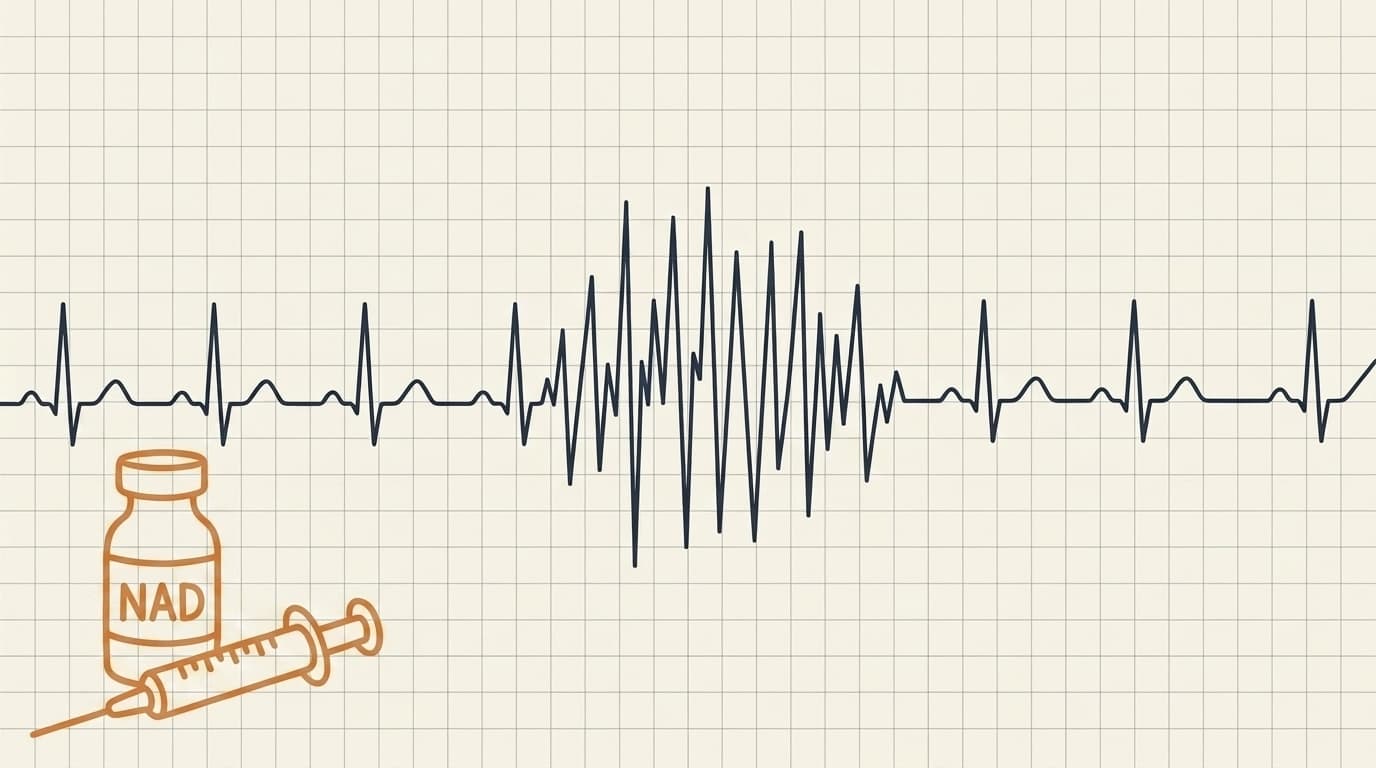
First, a correction I had to make on myself. NAD+ is not a peptide. It’s a molecule, a coenzyme that every cell in your body already makes and uses to turn food into energy. I lump it in with my peptides because I inject it right alongside them, so in my head it got filed with the rest of the rotation. It doesn’t belong in that category, and a lot of people make the same mistake, so it’s worth saying out loud before anything else.
Here’s what sets it apart from the actual peptides in that drawer. Most of the peptides I take, I inject them and I feel nothing. I shoot it, I go about my day, and whatever it’s doing happens quietly under the hood. NAD+ is one of the rare things I inject where you actually feel something. And if you inject a lot of it, you feel a lot of something.
I found that out the hard way a couple of weeks ago, and it sent me down a research hole that turned into this post.
How I got here
I didn’t design any of this. I found a 14-week mitochondrial protocol online, the kind that stacks NAD+ with SS-31 and MOTS-c and stages them out over the weeks. I liked the logic of it, so I ran the front half: NAD+ the whole way through, SS-31 layered on top.
I never ran the MOTS-c. I chickened out. I’d seen a lot of people report really rough histamine reactions to it, the flushing and hives kind, and I decided it wasn’t worth the risk for me right then. Fair warning that “a lot of people online said” is not the same thing as a study, and I couldn’t find real published data on MOTS-c and histamine when I went looking. It was a gut call, not an evidence call, and I’m telling you that so you can weigh it as one.
That first NAD+ run was pretty mild. A little flushing, a little chest tightness when I dosed, no nausea. The effects were subtle. I felt a small bump in my cardio in the gym. The weirdest one, about a week in, was that I felt like I needed my stimulants less. Afternoon coffee, pre-workout, I just wasn’t reaching for them the same way. Don’t get me wrong, I still took both of them, because I love stimulants. But the pull was quieter. That was the whole first run: nothing dramatic, nothing scary.
The second run is the one worth writing about.
The 200mg morning
I came back to NAD+ a couple weeks ago because I caught a sinus infection and wanted to see if it would help me fight it off. I asked the AI coach in my app about running it while sick, and its take was that acute use is its own thing, different from a long-term protocol. It built me a short run: 100mg a day for the first three days, then 200mg a day through day ten, dosed in the morning to keep it away from my evening peptides, and it told me to talk to my prescriber about any dose changes. Credit where it’s due, it also warned me straight up that NAD+ can cause a flushing and warmth reaction, that it gets worse with higher doses and faster injections, and to inject slowly, over thirty to sixty seconds, to keep it manageable. Hold that thought, because it turned out to matter.
The 100mg days felt like the first run. A little chest tightness, a little flushing, easy to ignore.
Then came the first 200mg morning. Here’s a detail that matters: my vial is 500mg, and I reconstituted it with 3mL of water, which puts it at about 167mg per mL. So a 200mg dose is 1.2mL, and that doesn’t fit in a 1mL syringe. I had to split it into two separate injections, and I pushed each one slow. Between the two shots, the whole thing took well over a minute. In other words, I did exactly what the coach told me to do on speed, and then some.
It didn’t matter. It was a different animal than the 100mg days. Quite a bit more flushing. Every so often a sudden jolt of warmth would roll through me out of nowhere. Real tightness in my chest. And underneath all of it, this low-level panic-attack feeling that I could not talk myself out of. It took a couple hours to fully pass. I was at work trying to concentrate and I just could not lock in.
Nothing about that was in the “energy and clarity” brochure. So I stopped, and before I decided whether to drop back to 100 and keep going, I wanted an actual answer to one question: what the hell is in NAD that makes you feel that way? Here’s what I found.
Why you feel NAD+ at all
Here’s the thing that reframed it for me. Most peptides are quiet because they slip into the machinery and go to work. NAD+ is loud because it mostly can’t.
NAD+ carries a negative charge, and that charge means it can’t just cross your cell membranes and walk inside the way a lot of molecules do. So when you inject a big slug of it, a lot of that NAD+ ends up sitting outside your cells, in the fluid and the bloodstream, where it does two things: it acts directly on a family of receptors on your cell surfaces called purinergic receptors (the same signaling system your body uses for ATP and adenosine), and it gets broken down, fast.
We actually have human data on how fast. The one published study that infused NAD+ into people and tracked the blood levels found that for the first couple of hours, the NAD+ basically disappeared as quickly as it went in. Your body clears it in real time. It’s being chopped up by surface enzymes almost immediately.
So the feeling isn’t your mitochondria getting topped off in the moment. Most of that acute hit is extracellular NAD+ bumping into receptors and getting metabolized right there in your blood and tissue. That’s the mechanistic version of “you feel it.” And it scales with how much you put in at once, which is exactly why 100mg was a shrug and 200mg in one morning shot was a wall.
It is not a “niacin flush,” even though it feels like one
First, what a niacin flush even is, because I assumed I knew and I didn’t. If you’ve ever taken a big dose of niacin, plain vitamin B3, you might have gotten a hot, red, prickly, almost itchy flush across your face and chest about twenty minutes later. It’s harmless, it passes on its own, and it’s common enough that it earned its own name. That’s the niacin flush.
The easy explanation you’ll see everywhere is that the NAD+ reaction is just that same flush. It even feels like one. But that story doesn’t actually hold up for NAD+.
The niacin flush comes from nicotinic acid hitting a specific receptor and triggering a wave of prostaglandins that dilate your skin’s blood vessels. When NAD+ breaks down, it doesn’t turn into nicotinic acid. It turns into nicotinamide and a few other fragments. And nicotinamide has essentially no activity at that niacin receptor. In the research it’s literally used as the negative control, the thing they give to prove the receptor isn’t firing.
Same red face, different door. Which matters, because if you assume it’s a niacin flush you’ll reach for niacin-flush fixes, and you’re aiming at the wrong mechanism.
The chest tightness and the dread: the adenosine story
This is the part I actually wanted answered, and it’s also the part where I have to be honest about the limits of what’s known.
When NAD+ gets broken down outside your cells, one of the paths it can go down ends in adenosine. And adenosine is not some obscure molecule. It’s a drug. Cardiologists inject it during stress tests, and the known, listed, expected side effects of an adenosine push are chest pressure, flushing, shortness of breath, and a “sense of impending doom.” That is almost word-for-word what I felt at 200mg.
So the cleanest explanation for the chest tightness plus the panic feeling is that a big bolus of NAD+ is getting metabolized down toward adenosine, and I was feeling a milder, homemade version of what a stress-test patient feels.
Here’s the honest caveat, and I’m keeping it in on purpose: nobody has actually measured adenosine going up in a human’s blood at the same time they measured the symptoms. The chain is built from solid pieces (we know the enzymes that would do it, we know they’re on your blood vessels, we know adenosine causes exactly these symptoms) plus one rat study showing blood adenosine rises after you infuse extracellular NAD+. It’s the best explanation on the table. It is not a proven one. Anyone who tells you they know for certain why NAD+ gives you chest tightness is ahead of the science.
Is it dangerous, or just miserable?
Both the studies and my own experience point the same way: this is dose-dependent, rate-dependent, and self-limiting. In every small human study I could find, the flushing and chest pressure showed up during the dose and stopped basically the moment the dose stopped. People who slowed their infusion way down had a much easier time than people who ran it fast. And the standard safety bloodwork, liver, kidney, inflammation markers, came back normal. Uncomfortable, not organ-toxic, at these kinds of doses.
That’s the reassuring read, and it’s real. But I’m not going to hand you a clean bill of health on chest tightness, because the honest truth is that none of those studies put someone on an ECG or checked cardiac markers while they were having the reaction. “It went away when I stopped and my labs were fine” is a good sign. It is not the same as “we proved your heart was fine.” If you’ve got any cardiac history, or the symptoms don’t fit the pattern I described, or they don’t pass, that is a doctor conversation and not a gut-it-out situation. Chest tightness is the one symptom I will never tell you to push through.
One more thing worth knowing, because it’s a different risk people blur together. There have been serious adverse events tied to injectable NAD+, including an FDA recall. But when you read them, they trace back to contaminated, non-sterile compounded product causing endotoxin reactions, the shaking-and-crashing kind, not the flush I’m describing. That’s a sourcing-and-sterility problem, not an NAD+-molecule problem. It’s an argument for caring a lot about where your vial came from, and it’s a separate issue from the dose reaction.
So why does anyone take this?
Fair question, and it’s the one I actually care about, because I’m an optimist by nature and I’m always hunting for a reason to add something to the stack. But if there’s truly nothing there, I can’t justify sticking myself for it.
The pitch you’ll hear is energy, mental clarity, anti-aging, DNA repair, faster recovery, feeling younger. The oldest version of it is the addiction and detox clinics that have run NAD+ IVs for decades. That’s the marketing.
Here’s the part that keeps me interested, and it’s not nonsense. NAD+ is one of the most central molecules in your entire body. You’ll see it called the transporter of energy in your cells, which is close enough to feel true but isn’t quite right. It doesn’t carry energy, it carries electrons. It grabs the high-energy electrons off the food you break down and ferries them to the machinery that turns them into the fuel your cells actually spend. Small distinction, but it’s the difference between understanding this molecule and repeating a slogan about it. On top of that, it’s the required fuel for two systems everybody in the longevity world cares about: sirtuins, the enzymes tied to a lot of the cellular housekeeping of healthy aging, and PARP, your DNA repair crew. Both of them burn NAD+ to do their jobs, and they fight over the same limited pool.
And two things here are actually established in people, not just mice: your NAD+ levels really do fall as you age, and the leading explanation is an enzyme called CD38 that chews up NAD+ and ramps up as you get older, though that CD38 part is better proven in mice than in humans so far. So the theory is clean and genuinely appealing. You’re running low on a molecule your repair and energy systems depend on, so put some back. That’s a real reason to be curious, and honestly it’s why I keep coming back to it.
It’s also exactly why the protocol I found ran NAD+ as the base layer the entire time. The idea was to keep the tank full first, because the other two compounds lean on it. SS-31 tunes how efficiently your mitochondria turn fuel into energy, but it needs those NAD+ carriers to work with. MOTS-c works partly through SIRT1, which only runs when NAD+ is around. Prime the fuel, then tune the engine. It’s a logical recipe. It’s also, I have to be straight with you, mostly theory. The one real study behind the NAD+ and SS-31 pairing was done in old mouse hearts, used an NAD+ pill instead of an injection, and didn’t involve MOTS-c at all. Nobody has run the actual three-compound stack in a person and measured a single thing.
But does it actually do anything?
Here’s where the optimist in me has to sit down.
For the injected NAD+ that I’m doing, there are zero human studies measuring whether it improves any outcome. Not energy, not focus, not insulin sensitivity, nothing. And the distinction matters: this isn’t a case where researchers put it to the test and it flopped. The test was never done in the first place. Everything published on injected or IV NAD+ is about how fast your body clears it and how well you tolerate it, the stuff I already walked through above.
The actual randomized human evidence, the real trials, is all for the oral precursors. Those are NR and NMN, nicotinamide riboside and nicotinamide mononucleotide, which are the pill forms your body converts into NAD+ once they’re inside you. And the trial record on the pills is a mixed bag that leans slightly positive on a couple of specific things. One well-run trial found that 250mg of NMN a day for ten weeks improved insulin sensitivity in prediabetic women, measured with the gold-standard clamp test, not a questionnaire. A separate trial found that a gram of NR a day nudged down blood pressure and arterial stiffness in middle-aged and older adults. Those are real wins on hard numbers, not vibes. But they’re small, thirty people or fewer, each one hitting a single narrow endpoint in a specific group, none of them repeated yet by an outside lab, and sitting right next to them is a trial where NR did nothing for exercise capacity. So the honest read is: a real signal, a fragile one, and for the pill, not the needle.
And that oldest, most-marketed use, the addiction and detox IV clinics? That one has the weakest evidence of the whole bunch. The only outcome data comes from the same company that sells the treatment, with no control group to compare against. That’s not evidence. That’s a brochure with footnotes.
So my little cardio bump and my quieter coffee cravings from the first run? That’s an n of one. Me. Anecdote. I’m not going to dress it up as proof, and you shouldn’t take it as any.
Where I landed
I stopped the run. The protocol was basically over anyway, and I was already feeling better from the sinus infection, so I didn’t drop back to 100 and grind out the last days. I wanted to understand what happened first, which is the whole reason this post exists.
Here’s what surprised me when I dug in: I’d actually done the careful part right. I split the dose and injected slow, so speed was never my problem. For me the lever was the size of the jump. Going straight from 100 to 200 in one step was too much, too fast, for my body to keep up with, and the flush-and-dread is what that overload feels like.
So here’s where I actually land. I’ve still got 800mg of injectable NAD+ left, and I’m not throwing it out. I haven’t found a shred of evidence it does anything harmful, and the reaction I had, rough as it felt, was the uncomfortable-not-dangerous kind that passes. So it stays in the drawer. If I’m dragging some week and want a little pick-me-up, maybe I run 100mg for a couple weeks and see if it does anything for me. Low and slow, not the 200 that lit me up.
But it is not going to be the foundation of my stack. That’s the real thing the research changed for me. The whole case for running NAD+ as the base layer rests on a mechanism that’s genuinely elegant and, for the injected form, almost entirely unproven in humans. So I’ll keep it around as an occasional experiment, not a cornerstone. And the one lesson I’m keeping no matter what: don’t double a dose in a single jump. Small steps, slow shots.
If you’re going to run it, my honest take: start lower than you think, step the dose up gradually instead of doubling it, inject slow, and know that the flush and even the weird dread are a known and usually passing reaction. Also know that “usually passing” is not a promise, so keep the chest-tightness line I drew above. And go in clear-eyed that the benefits are a lot less proven than the vibe around this stuff implies.
I track all of this in my own app, doses, how I felt, side effects by day, which is how I can tell you the 100mg days from the 200mg days without guessing. The app is also what did the reconstitution math that told me 200mg was more than one syringe would hold. That’s the point of writing any of it down. You can’t spot your own dose-response if you’re running on memory.
Sources
- Grant R. et al., “A Pilot Study Investigating Changes in the Human Plasma and Urine NAD+ Metabolome During a 6 Hour Intravenous Infusion of NAD+,” Front Aging Neurosci 11:257, 2019. The only human IV NAD+ pharmacokinetic study: near-complete real-time clearance over the first couple of hours, and the degradation cascade. PubMed.
- Kamanna V.S., Ganji S.H., Kashyap M.L., “The mechanism and mitigation of niacin-induced flushing,” Int J Clin Pract 63(9), 2009. The niacin flush is prostaglandin-driven via the GPR109A receptor, and nicotinamide has essentially no activity there. PubMed.
- Singh A., McKintosh R., “Adenosine,” StatPearls. The listed side effects of an adenosine push: chest pressure, flushing, shortness of breath, and a sense of impending doom. NCBI.
- Szczepańska-Konkel M. et al., 2003. The rat study showing blood adenosine rises after infusing extracellular NAD+, the inferred (not human-proven) link in the adenosine story. PubMed.
- Moreschi I. et al., “Extracellular NAD+ is an agonist of the human P2Y11 purinergic receptor in human granulocytes,” J Biol Chem 281, 2006. Extracellular NAD+ acts directly on purinergic receptors. PubMed.
- Reyna N.C. et al., Front Aging 7, 2026. Clinic tolerability data: NAD+ infusion subjects reported cramping, GI symptoms, and chest pressure that ceased when the infusion ended, and they self-slowed the rate. PubMed.
- Radenkovic D., Reason, Verdin E., “Clinical Evidence for Targeting NAD Therapeutically,” Pharmaceuticals 13(9), 2020. The review that calls the human evidence promising yet speculative. PubMed.
- Gallagher C., Emmanuel J. et al., Ageing Research Reviews, 2026. Systematic review finding no eligible outcome trials have tested IV or IM NAD+ for anti-aging or wellness. PubMed.
- FDA, “FDA reminds compounders to use ingredients that are suitable for sterile drug compounding,” October 30, 2024. The endotoxin recall tied to contaminated compounded NAD+ product, a contamination problem, not a molecule problem. FDA.
- Clement J. et al., “The Plasma NAD+ Metabolome Is Dysregulated in ‘Normal’ Aging,” Rejuvenation Res 22(2), 2019. Human plasma NAD+ declines steeply with age, ages 20 to 87. PubMed.
- Camacho-Pereira J. et al., “CD38 Dictates Age-Related NAD Decline and Mitochondrial Dysfunction through an SIRT3-Dependent Mechanism,” Cell Metab 23(6), 2016. CD38 as the driver of age-related NAD+ decline, in mice. PubMed.
- Imai S., Guarente L., “NAD+ and sirtuins in aging and disease,” Trends Cell Biol, 2014. NAD+ as the required fuel for the sirtuins; the lifespan link is in model organisms. PMC.
- Yoshino M. et al., “Nicotinamide mononucleotide increases muscle insulin sensitivity in prediabetic women,” Science 372(6547), 2021. The NMN 250mg/day, ten-week clamp-test trial (n=25). Science.
- Martens C.R. et al., “Chronic nicotinamide riboside supplementation is well-tolerated and elevates NAD+ in healthy middle-aged and older adults,” Nat Commun 9:1286, 2018. The NR 1000mg/day blood pressure and arterial stiffness pilot (n=30 crossover). PubMed.
- Whitson J.A. et al., Aging Cell 19(10), 2020. The NAD+ (via NMN) plus SS-31 synergy study in aged mouse hearts, the one real datapoint behind the NAD+ base-layer logic. PubMed.
This is educational, not medical advice, and I’m not a doctor. I’m a guy who takes this stuff, tracks it, and reads the research. Talk to your own prescriber before you start, change, or stack anything, and take chest symptoms seriously.

Written by
Jason Jeffries
Founder of Frontload. Data analytics by day (12 yrs), training for 20, juggling a full-time job, family, and app development. I run TRT and peptides myself, and I built Frontload because my whole tracking system was a notebook in a drawer in my bathroom. I’m not a doctor and none of this is medical advice.
FRONTLOAD
Track it instead of guessing.
Doses, bloodwork, and an AI coach grounded in your own data — free to start, on the App Store and Google Play.