I Tried to Lower My Estradiol Without an Aromatase Inhibitor for Two Months. It Went Up.
Two months ago I had two tools I was avoiding and a drawer full of anastrozole I would not open. I spent the time on everything else instead. Here is the number that came back, and what I am doing about it.
By Jason Jeffries · September 8, 2026
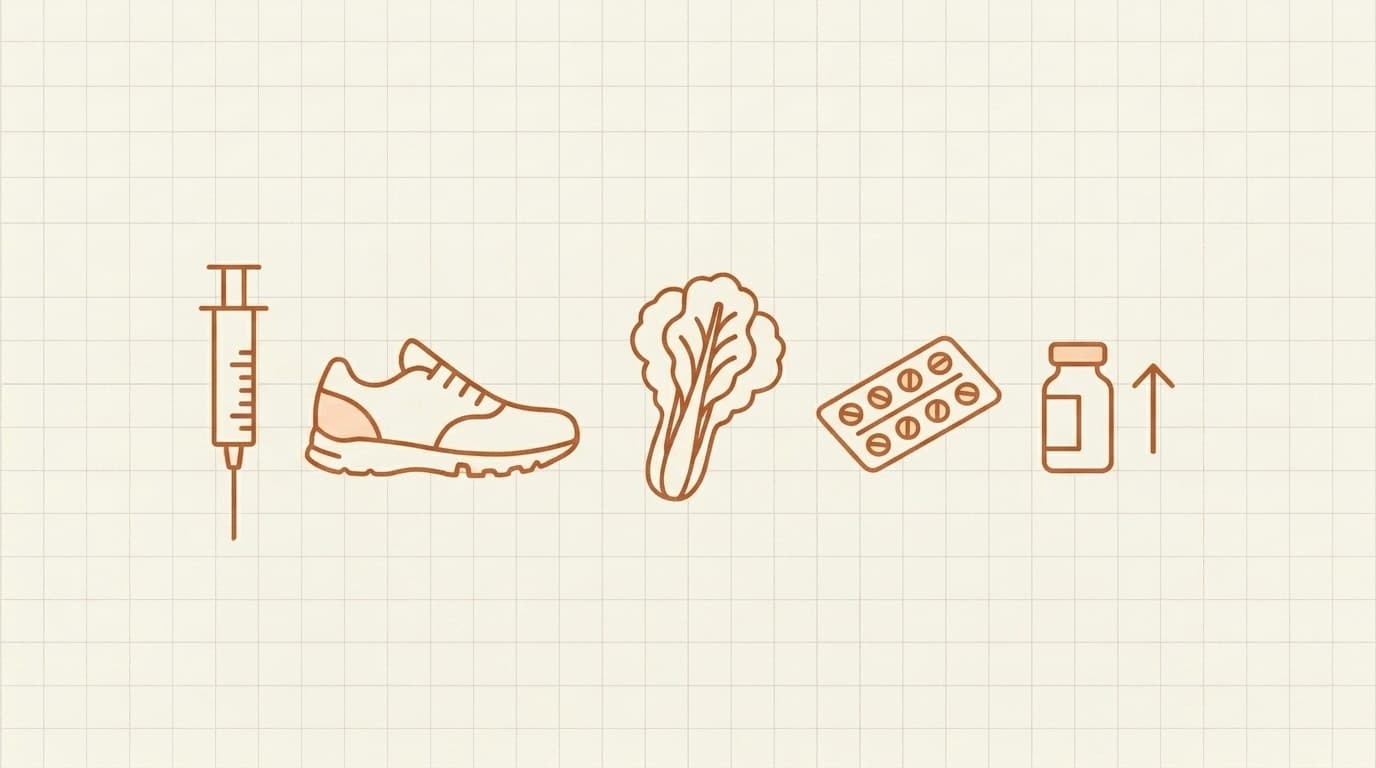
Two months ago I wrote about my estradiol coming back high on TRT, and the box of anastrozole I have never opened. My prescriber gave me the two standard options, take an aromatase inhibitor or lower my dose, and I decided to spend two months on everything else first. More frequent injections, more cardio, more fiber. Then draw again and see if the low-risk levers did anything.
I promised, in writing, that if they did nothing I would say so. So here I am.
The number
My estradiol came back at 74. My trough draw two months earlier, on the exact same dose and schedule, was 66. Same lab, same ultrasensitive LC/MS assay, same time of day, both at trough right before my next shot. My Quest report lists the top of the range for this assay at 29.
It went up.
I want to be fair about the size of it. 66 to 74 is eight points, and on a single draw either side, estradiol has real day to day scatter, so some of that gap could be noise. But I did not run this experiment to split hairs over eight points. The goal was to get the number down, and it did not go down. That is the honest result.
Here is what makes it strange
I did not half do this. Over those two months I kept the injections at three times a week, I put in the cardio, I added the fiber, and I got leaner. A DEXA scan on August 26 put me at 13.8 percent body fat, and I lost body weight between the two blood draws. And my testosterone actually came down a little, from 1277 to 1200 total, with my free testosterone dipping too, both still over the top of the range.
That last part matters. The usual story is that high estradiol rides on high testosterone, more testosterone means more raw material to convert. But mine did not go up, it drifted down, and my estradiol went up anyway. So I cannot even hand you the tidy explanation. I did the leaning out, I did the cardio, I did the fiber, my testosterone dipped, and the one number I was chasing moved the wrong way.
I do not have a clean mechanism for you. My best honest read is that the low-risk levers just do not move estradiol much for a man whose baseline runs where mine does, and that a chunk of those eight points might be normal variation. That is not a satisfying answer. It is the true one.
It was not wasted
Here is the part I did not expect. Almost everything else on the panel got better. My hematocrit dropped from 49.8 to 47.4, and for anyone on testosterone that is the number that actually carries risk. My CRP went from 1.5 to 0.6. My LDL came down. The cardio and the leaning out did real work. It just did not do the one job I had picked for it.
So I am not calling two months of cardio and fiber a failure. I am calling it a reminder that your body does not owe you the specific result you were after, even when you do the work.
What I am doing now
I made myself a promise in the first post, that if the lifestyle changes did nothing I would use one of the two tools I had been avoiding. They did nothing for estradiol. So I am keeping it.
The anastrozole is staying in the drawer. I still have zero symptoms, no tenderness, no swelling, nothing, and everything I wrote last time about being more scared of low estradiol than high still stands, the fat gain, the bone loss, the libido and erectile function that need estrogen present. None of that changed. What I am doing instead is lowering my dose, from 150mg a week to 120. Less testosterone means less to convert, and it goes at the root rather than blocking the enzyme downstream.
The timing is the one wrinkle. I am in a cut right now and I want to hold onto muscle while I am in a deficit, and keeping the dose where it is helps me do that through the end of October. So the drop happens at the start of November, not today. That is a deliberate trade, muscle retention now, the estradiol handled right after.
The thing to take from this
The internet will hand you a confident number for where your estradiol should sit and a confident list of things that will get it there. My own body just handed me a messier answer than any of them. I did the leaning out and the cardio and the fiber, the levers everyone recommends, and it went up.
If you take one thing from this, take the same thing as last time. Draw at the same time, on the same assay, every time, or your own numbers will lie to you. I built Frontload so every lab result sits next to the protocol and the log that produced it. You can also read more about estradiol in the compound library, free, no account.
Related: my first post on this and is more testosterone actually better?
Frequently asked questions
Did injecting more often, cardio, and fiber lower my estradiol?
No. I ran all three for two months, three injections a week instead of two, more cardio, more fiber, and my estradiol went from 66 to 74 on the same assay at the same trough timing. It went up, not down. The mechanisms behind those levers are real, but for me they did not move the number I was chasing, and some of that eight point change could be normal variation. The honest result is that the low-risk levers did not do the job.
Should I test estradiol at peak or trough?
Pick one and never move off it. My own numbers make the case. Earlier I drew 75 about 24 hours after an injection and 66 at trough on the identical dose, nine points apart from timing alone. Trough is the easier one to reproduce because it is just before your next shot, but consistency matters more than which you pick. A number with no draw time attached cannot be compared to anything, including your own previous result.
Why did my estradiol go up even though I got leaner?
I do not have a clean mechanism for you. The usual story is that high estradiol rides on high testosterone, so less body fat and less testosterone should mean less conversion. But my testosterone actually drifted down over those two months, from 1277 to 1200 total, and I got to 13.8 percent body fat, and estradiol still went up. My best honest read is that the low-risk levers just do not move it much for a man whose baseline runs where mine does.
Why lower the dose instead of taking an aromatase inhibitor?
Because I am more worried about ending up with low estradiol than high, and lowering the dose goes at the root, less testosterone means less to convert, instead of blocking the enzyme downstream. I still have zero symptoms, so I am not in a rush. I am dropping from 150mg a week to 120, but not until the start of November, because I am in a cut right now and keeping the dose where it is helps me hold muscle in a deficit through the end of October.
Is an eight point change even real, or is it noise?
Some of it could be noise. Estradiol has real day to day scatter, and 66 to 74 is a single draw on each side. I did not run this to argue over eight points though. The point was to get the number down, and it did not go down, so I am treating the levers as having not worked rather than reading too much into the exact figure.
Sources
- The numbers here are my own lab results, from my own draws, on my own protocol. That makes them real and it makes them a sample of one. Nothing about my estradiol generalizes to anyone else.
- Which assay produced the number matters as much as the number. Reference ranges are lab specific. My Quest ultrasensitive LC/MS report lists the top of the range at 29 pg/mL, while the general adult male range you will see cited runs wider, around 10 to 40. Either way my 66 and 74 are over the top of my reported range. And the standard immunoassay reads differently at these levels, so results from the two methods cannot be compared or plotted as one trend.
- What I deliberately do not claim: that the lifestyle levers do not work for anyone, or that lowering the dose is the right move for you. This is one person, two draws, and a plan for what I am doing next. Anyone giving you a confident general rule about managing estradiol on testosterone, in either direction, is ahead of the evidence.
This is my own experience and general education, not medical advice. It is not a recommendation to start, change, or stop testosterone, to change an injection schedule, or to take or avoid any medication. My prescriber is aware of my bloodwork and of what I am doing. Every person has different physiology, labs, and risks, so talk to a qualified medical provider about your own.

Written by
Jason Jeffries
Founder of Frontload. Data analytics by day (12 yrs), training for 20, juggling a full-time job, family, and app development. I run TRT and peptides myself, and I built Frontload because my whole tracking system was a notebook in a drawer in my bathroom. I’m not a doctor and none of this is medical advice.
FRONTLOAD
Track it instead of guessing.
Doses, bloodwork, and an AI coach grounded in your own data — free to start, on the App Store and Google Play.